
If you are currently sitting at a ‘C’ grade in IGCSE or O-Level Physics and Mathematics, the barrier to an ‘A*’ is rarely a lack of intelligence. Instead, it is a systemic failure to align your answers with the specific, often hidden, requirements of the examiners.
With exams roughly 60 days away, reading the textbook is no longer a viable strategy. Moving to the top tier demands a total recalibration of how you interact with the syllabus, the marking scheme, and the clock.
Here is an exhaustive 60-day intervention designed to help you stop passively reading, hack the assessment process, and secure every available mark.
1. Decode the Mark Scheme (Think Like an Examiner)
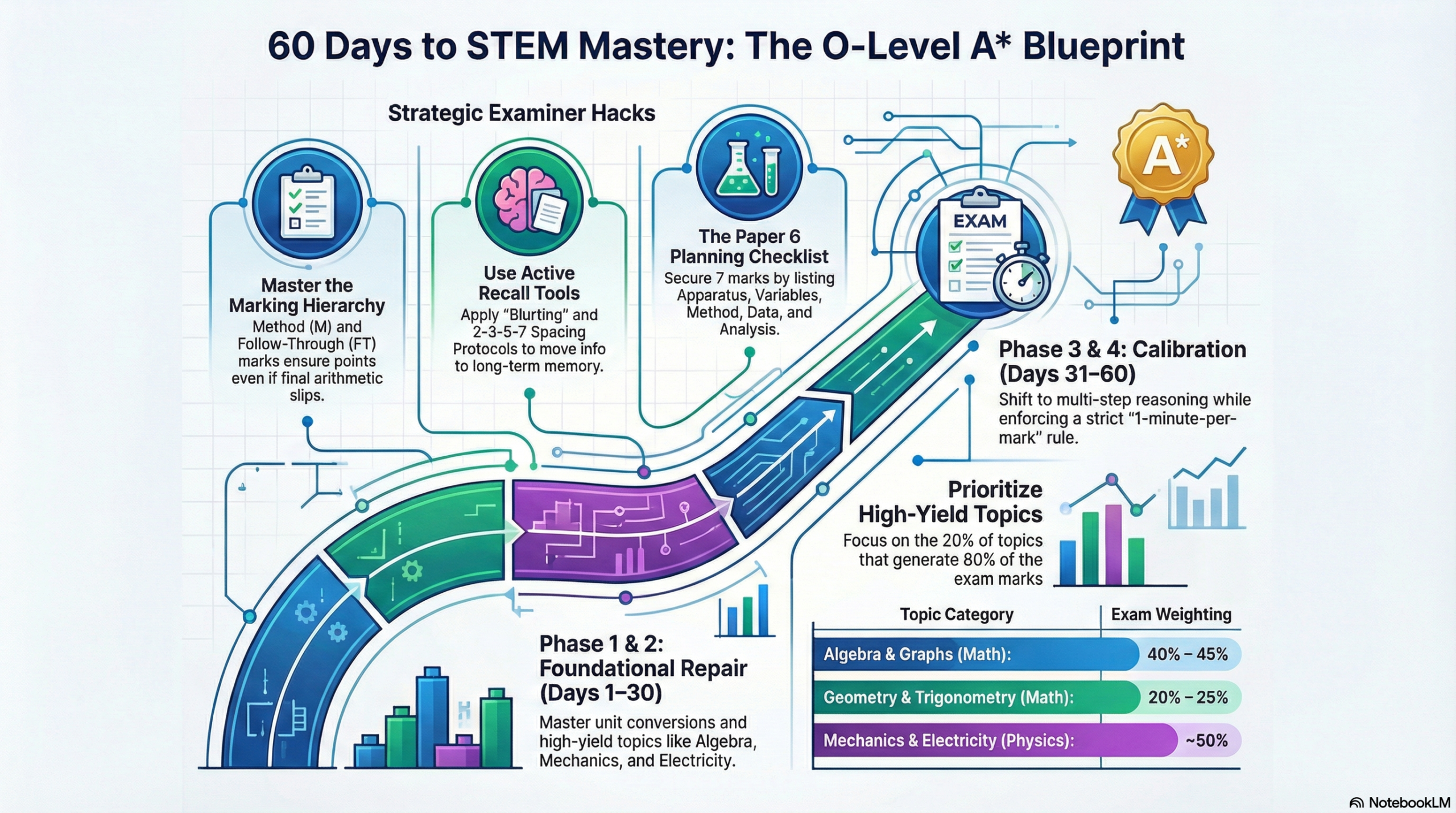
To elevate your grade, you must transition from being a “learner” to a “candidate.” Examiners do not mark based on what you know; they mark what is explicitly demonstrated on the page. Understanding the hierarchy of marks is your first major hack:
- Method (M) Marks: These are the cornerstone of STEM exams. They are awarded for applying the correct process.
- Accuracy (A) Marks: An Accuracy mark cannot be awarded without the preceding M mark. If you punch numbers into a calculator and write the correct final answer but show zero working, you will score zero.
- Follow Through (FT) Marks: If you make an error in part (a) of a question but use that incorrect answer flawlessly in part (b), you can still secure FT marks. Always leave a clear trail of evidence to salvage marks if your final arithmetic slips.
Download the official Cambridge marking schemes here.
2. Focus on High-Yield Topics (The Pareto Principle)
Efficiency in a 60-day window is achieved by prioritizing topics that represent the largest percentage of the exam paper.
- Math (0580 / 4MA1): Algebra and Graphs dominate the assessment, accounting for 40% to 45% of total marks in Extended papers. Factorizing, rearranging formulas, and solving quadratics are mandatory skills. Geometry and Trigonometry make up another 20% to 25%.
- Physics (0625 / 4PH1): General Physics (Mechanics) and Electricity & Magnetism combine to form nearly half of the available marks. Furthermore, the recent introduction of Space Physics (8% to 12% of marks) provides “low-hanging fruit” as the questions are highly predictable.
Read my complete breakdown of GCSE Maths Topics Ranked from Easiest to Hardest
3. The 60-Day Action Plan
Divide your turnaround into four distinct 15-day phases.
Phase 1: Foundational Repair (Days 1–15)
Address the “fragile foundation” that causes ‘C’ students to fail non-standard questions.
- Math: Focus on numerical literacy. Master standard form, reverse percentages, and simple equation manipulation.
- Physics: Master unit conversions and formula transposition. A common reason for a ‘C’ grade is forgetting to convert minutes to seconds or grams to kilograms before substituting them into a formula.
Phase 2: High-Yield Concept Immersion (Days 16–30)
Pivot to the topics that define the boundaries between a ‘B’ and an ‘A*’.
- Math: Dive deep into Quadratics, Simultaneous Equations, and Coordinate Geometry. Don’t just learn to solve them; learn to relate the roots of an equation to the intercepts on a graph.
- Physics: Focus heavily on Electricity and Space Physics. Understand that in series circuits, current is conserved while potential difference splits, whereas in parallel circuits, the opposite is true.
Phase 3: The Problem-Solving Pivot (Days 31–45)
Transition from topical study to multi-step problem solving.
- Math: Tackle “Circle Theorems” and “Vector Proofs.” Decompose complex geometry into right-angled triangles to apply Pythagoras or Trigonometry.
- Physics: Focus on Paper 4 long-answer questions (worth 4 to 6 marks) that require a “chain of reasoning.” For example, when explaining evaporation, don’t just say “it gets hot.” Explain that molecules have a range of energies, the most energetic overcome attractive forces, escape the surface, and lower the average kinetic energy of the remaining liquid.
Phase 4: Final Calibration and Simulation (Days 46–60)
Ditch the textbook entirely and work exclusively with past papers from the last five years.
- Enforce a strict “1-Minute-Per-Mark” rule.
- Mark your own work ruthlessly using the official marking schemes.
- Read Examiner Reports to avoid the “C-to-D trap”: vague language (using “it” instead of “electrons” or “resultant force”) and premature rounding.
4. Upgrade Your Study Techniques and Tools
Stop passively reading or highlighting textbooks; this creates a “fluency illusion” that vanishes the moment you sit in the exam hall.
- The 2-3-5-7 Spacing Protocol: Review a new concept 2 days after initial study, then 3 days later, then 5, then 7. This forces the brain to encode information into long-term storage, combating the forgetting curve.
- The “Blurting” Technique: Read a page of Physics definitions or Math formulas, close the book, and write down everything you can remember on a blank sheet. Use a red pen to fill in the gaps. This instantly identifies your weak spots.
- Calculator Hacks: Treat your Casio ClassWiz like a mini-computer. Use the Polynomial solver to instantly check the roots of a quadratic equation, or the Simultaneous Equation solver to verify your algebra. Always use the ‘Ans’ button to avoid premature rounding.
Check out my guide on How to Use AI for IGCSE Revision to generate parallel practice questions.
5. The Ultimate Physics Paper 6 Hack
Physics Paper 6 (Alternative to Practical) represents 20% of your final grade and is the easiest paper to hack. Every exam features a 7-mark planning question. You can consistently secure all 7 marks by following this mental checklist:
- Apparatus (1 Mark): Name specific tools (e.g., stopwatch, meter ruler, ammeter).
- Variables (1 Mark): Explicitly list the Independent, Dependent, and at least two Controlled variables.
- Method (2 Marks): Provide clear, numbered steps. Always include “Repeat the experiment at least five times and calculate an average.”
- Data Collection (1 Mark): Draw a table with headings and units (e.g., “Time / s”).
- Analysis/Conclusion (2 Marks): State how to reach a conclusion (e.g., “Plot a graph of [independent variable] on the x-axis and [dependent variable] on the y-axis”).
An ‘A*’ grade is not a gift reserved for the “naturally gifted”—it is a reward for the technically precise and strategically prepared.
Stick to this 60-day blueprint, respect the marking scheme, and watch your grades transform.
Blog
This section provides an overview of the blog, showcasing a variety of articles, insights, and resources to inform and inspire readers.
-
5 Powerful IGCSE Physics Topics to Master Before May
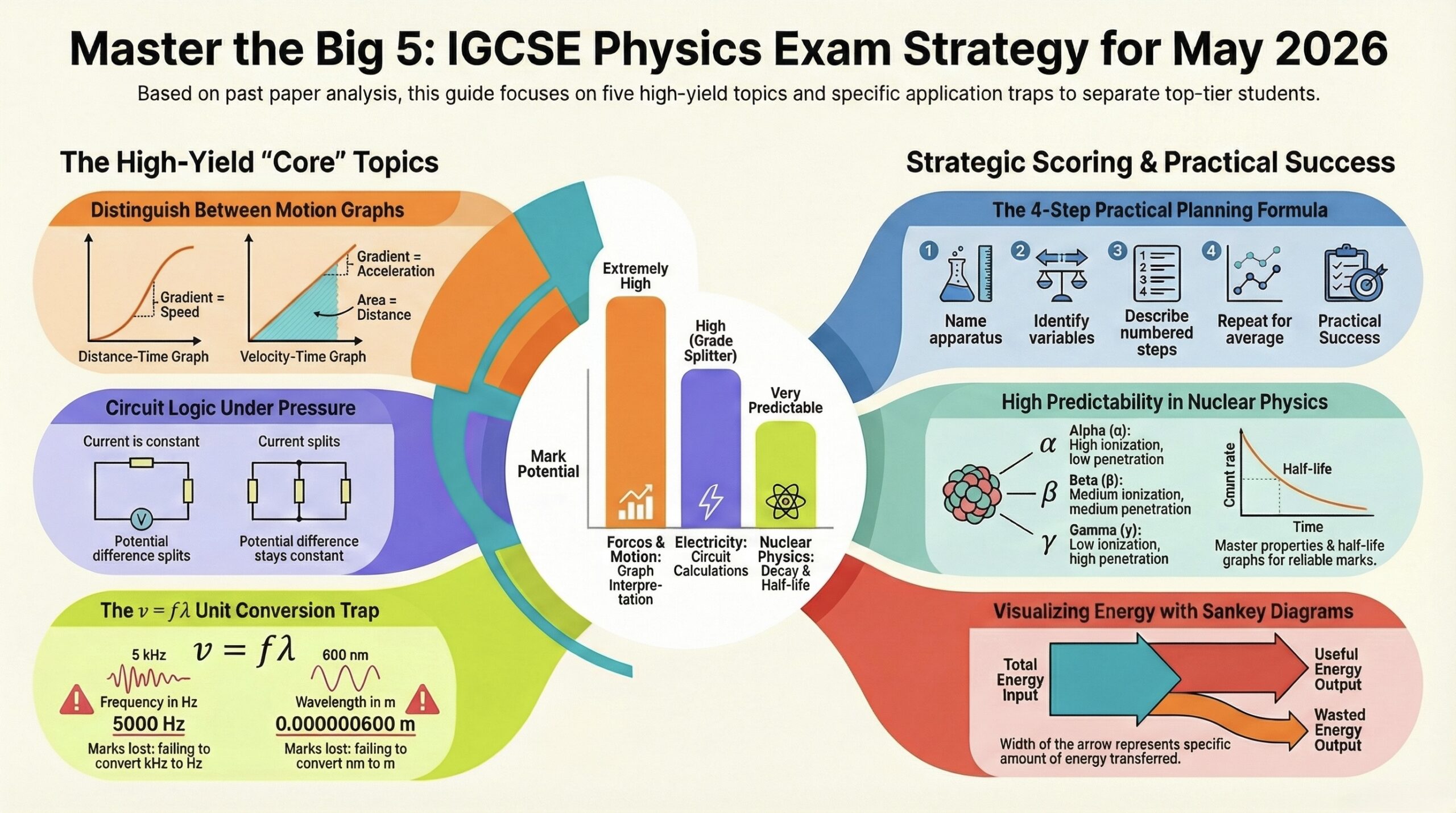
Spread the loveEight weeks out. Here are the five Physics topics most likely to cost you marks in May 2026, and exactly how to prepare for each one. By Muneeb Farooq · March 2026 · 8 min read · For Students Let me…
-
Are Predicted Papers Worth It? Honest IGCSE 2026 Truth
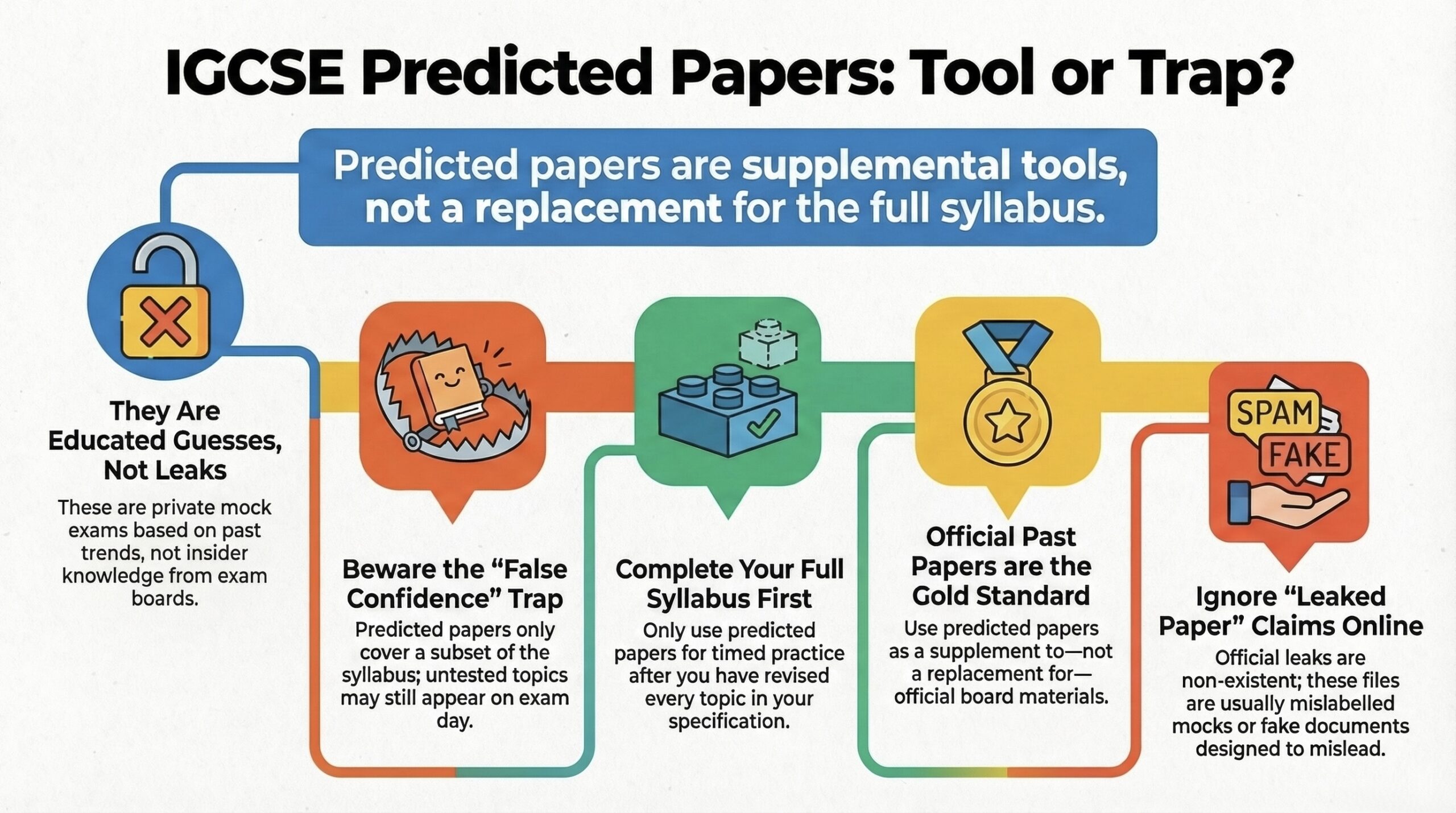
Spread the loveEvery student is searching for them right now. But do predicted papers actually help, or are they a dangerous distraction with 8 weeks to go? By Muneeb Farooq · March 2026 · 7 min read · For Students Every March, the…

Leave a Reply