
If your child is sitting for their GCSE or IGCSE exams in 2026; whether in Dubai, Riyadh, Doha, Muscat, Cairo, Amman, or Kuwait City, the rules of the game are shifting.
From confirmed formula sheets to brand-new qualifications launched specifically for the Middle East, staying updated is the first step to securing top grades. As we approach the final 8-week sprint before exam season, here is the critical intelligence every student and parent needs to know, and exactly how to act on it.
1. Exam Season 2026: The Critical Dates
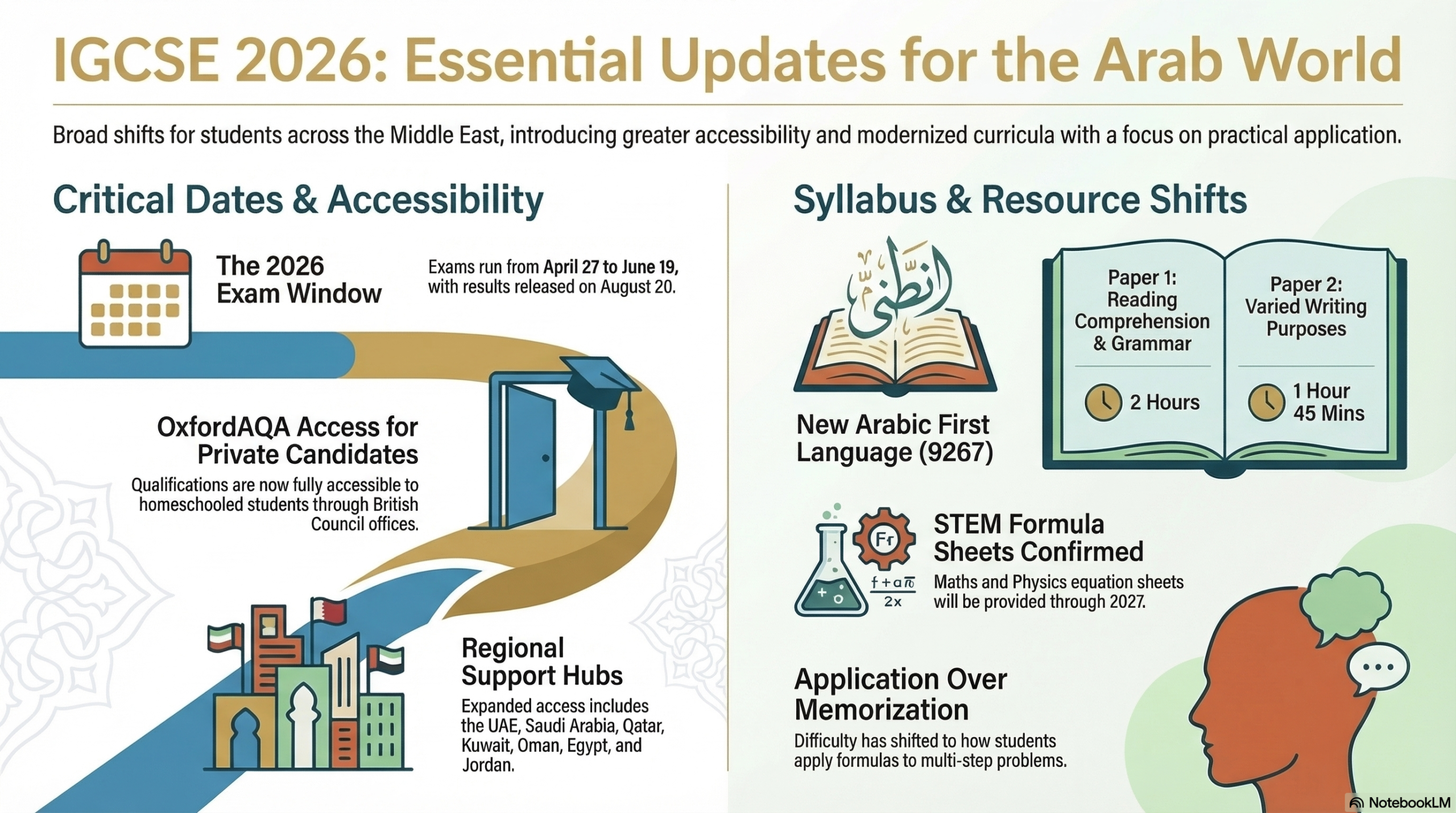
The summer 2026 exam window is officially locked in. Time is no longer an abstract concept; it is a countdown.
- OxfordAQA May/June Series Begins: Monday, 27 April 2026
- General Exam Window (AQA, Edexcel, Cambridge): Monday, 4 May 2026 – Friday, 19 June 2026
- Results Day: Thursday, 20 August 2026
Action Step: Do not rely on a generic Google search for your timetable. OxfordAQA, Cambridge (CIE), and Pearson Edexcel all publish slightly different schedules. Go to your specific exam board’s website today, download the official timetable, and stick it above your desk.
Download the official OxfordAQA and Cambridge timetables here.
2. OxfordAQA Opens Doors for Private Candidates
One of the most significant shifts for families in the region: OxfordAQA qualifications are now fully accessible to private candidates, including homeschooled students, through British Council offices across the Arab world.
- Eligible Countries: United Arab Emirates, Saudi Arabia, Qatar, Kuwait, Oman, Egypt, and Jordan.
- The Dubai Advantage: In the UAE specifically, OxfordAQA exams are offered three times per year: January (AS/A-level), May/June (IGCSE, AS/A-level), and October/November (selected subjects). This makes OxfordAQA one of the most flexible options for international students who need to pace their workload.
Pro-Tip for Parents: If your child is homeschooling or needs to retake a subject outside of their standard school schedule, contact your local British Council immediately to confirm private registration deadlines.
3. BREAKING: The New Arabic First Language IGCSE (9267)
OxfordAQA has just announced seven new international qualifications, headlined by the highly anticipated International GCSE Arabic – First Language (9267).
Unlike older legacy exams, this syllabus has been specifically engineered for international and multicultural schools. The content is culturally relevant, modernized, and designed to test genuine communication rather than just archaic memorization.
View the complete syllabus and specification for the new 9267 Arabic First Language qualification.
- First Teaching: September 2026
- First Exams: May/June 2028
- Structure: Paper 1 focuses on Reading Comprehension & Grammar (2 hours); Paper 2 focuses on varied Writing purposes (1 hr 45 mins).
Action Step: If you have a child currently in Year 8 or 9, speak to their school’s academic coordinator now to see if they will be transitioning to this new, modernized 9267 specification.
4. Formula Sheets Confirmed: A Trap or a Tool?
Great news for students studying STEM: Ofqual and the Department for Education have officially confirmed that formulae and equation sheets will continue to be provided in exams for 2025, 2026, and 2027.
You do not need to memorize standard formulas for GCSE/IGCSE Maths, and Physics equation sheets will be provided for AQA, Edexcel, and OCR boards.
The Danger Zone: Many students hear this and think the exam just got easier. It didn’t. The examiners have simply shifted the difficulty from memorization to application. If you just rely on the sheet without understanding how to transpose the formula or apply it to a multi-step problem, you will still drop the marks.
Read the official Ofqual confirmation regarding the 2025–2027 equation sheets.
Action Step: Print the exact 2026 formula sheet for your tier (Foundation or Higher) today. Use it during every single past paper you practice. You must build muscle memory so you aren’t wasting time searching the sheet during the actual exam.
Not sure which topics require the heaviest formula application? Check out my breakdown of GCSE Maths Topics Ranked from Easiest to Hardest.
5. The 8-Week Sprint: What to Do Next
With exams starting in roughly 8 weeks, reading textbooks is no longer a viable strategy. It is time to transition into full exam-hacking mode.
- Stop highlighting: Passive reading creates a “fluency illusion.” You need active recall.
- Start topical past papers: If you struggle with Physics Kinematics or Math Algebra, isolate those topics and do 5 years of classified papers.
- Hunt for Method Marks: Study the marking schemes. Examiners don’t just mark the final answer; they mark the exact steps you took to get there.
If you are stuck at a ‘C’ grade with only two months left, read my 60-Day STEM Turnaround Blueprint to completely restructure your revision.
Stop Guessing. Start Securing Marks.
I specialize in helping students across the Arab world and beyond master IGCSE Maths, Physics, and Chemistry (AQA, OxfordAQA, Cambridge, and Edexcel).
If you are panicked about the upcoming exam season, we can fix it. In a single session, we can identify exactly which topics are costing you marks and build a ruthless, personalized plan to fix them before May.
Book your Free 30-Minute Diagnostic Session right here.
Blog
This section provides an overview of the blog, showcasing a variety of articles, insights, and resources to inform and inspire readers.
-
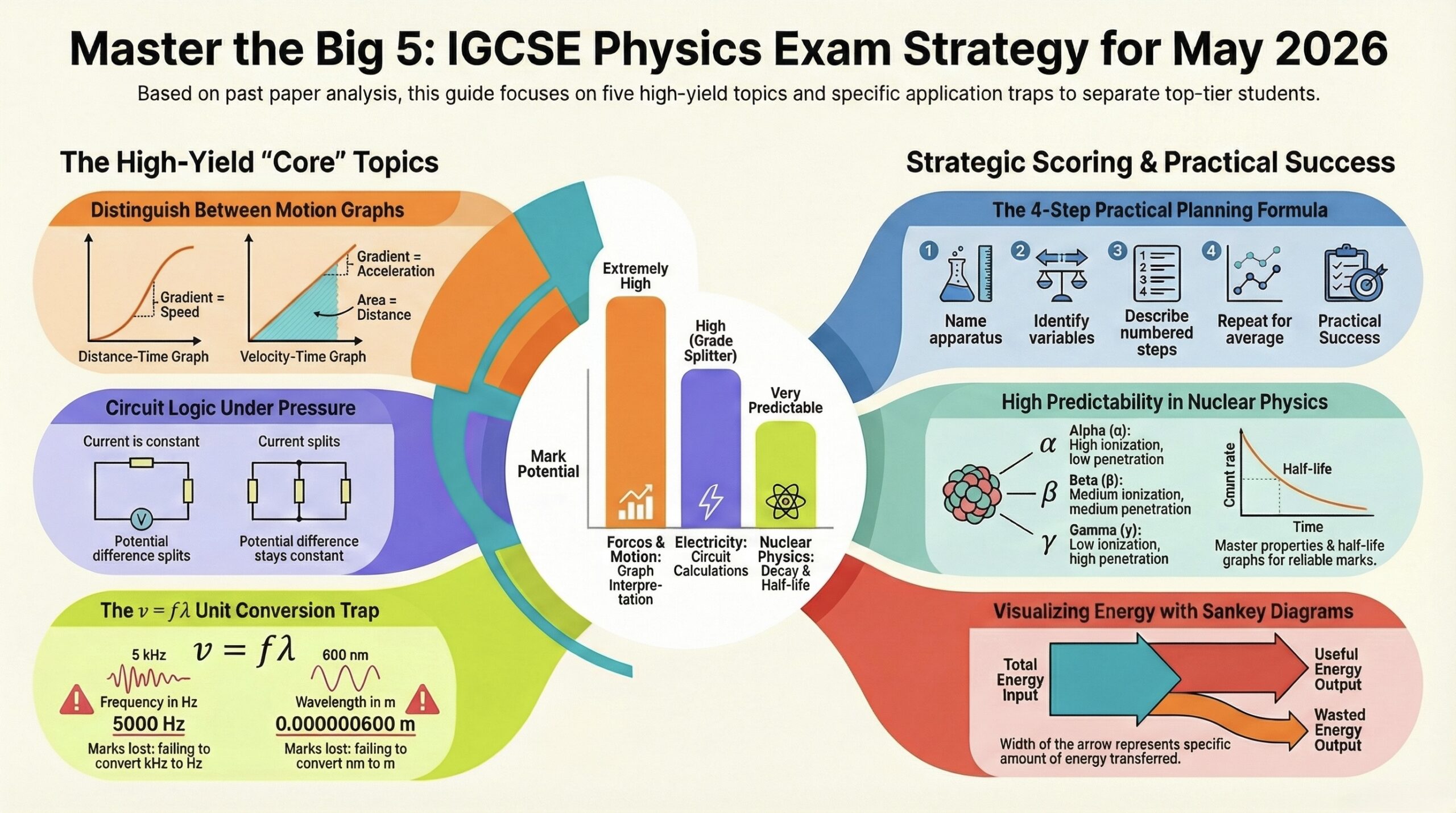
5 Powerful IGCSE Physics Topics to Master Before May
Spread the loveEight weeks out. Here are the five Physics topics most likely to cost you marks in May 2026, and exactly how to prepare for each one. By Muneeb Farooq · March 2026 · 8 min read · For Students Let me…
-
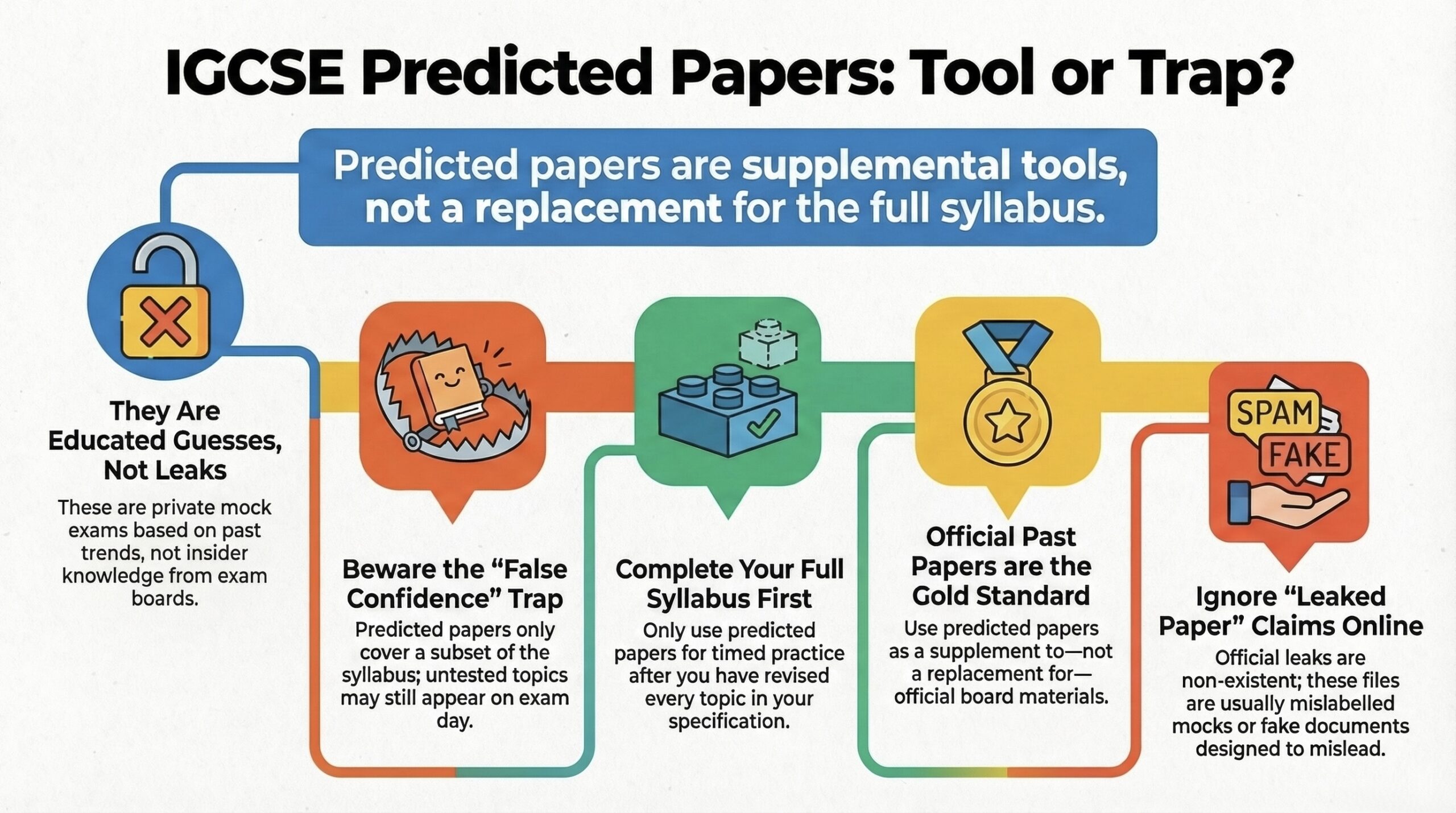
Are Predicted Papers Worth It? Honest IGCSE 2026 Truth
Spread the loveEvery student is searching for them right now. But do predicted papers actually help, or are they a dangerous distraction with 8 weeks to go? By Muneeb Farooq · March 2026 · 7 min read · For Students Every March, the…

Leave a Reply