
Every year, thousands of students open their GCSE Maths textbooks and instantly feel overwhelmed by the sheer volume of content. The biggest mistake you can make is treating every topic as if it requires the exact same amount of time and energy.
To conquer the syllabus, you need a strategy. Based on candidate performance data and examiner insights, the GCSE Maths curriculum isn’t just a random list of equations; it is a structured hierarchy.
Here is the definitive ranking of GCSE Maths topics from easiest to hardest, followed by the exact systems you need to master them.
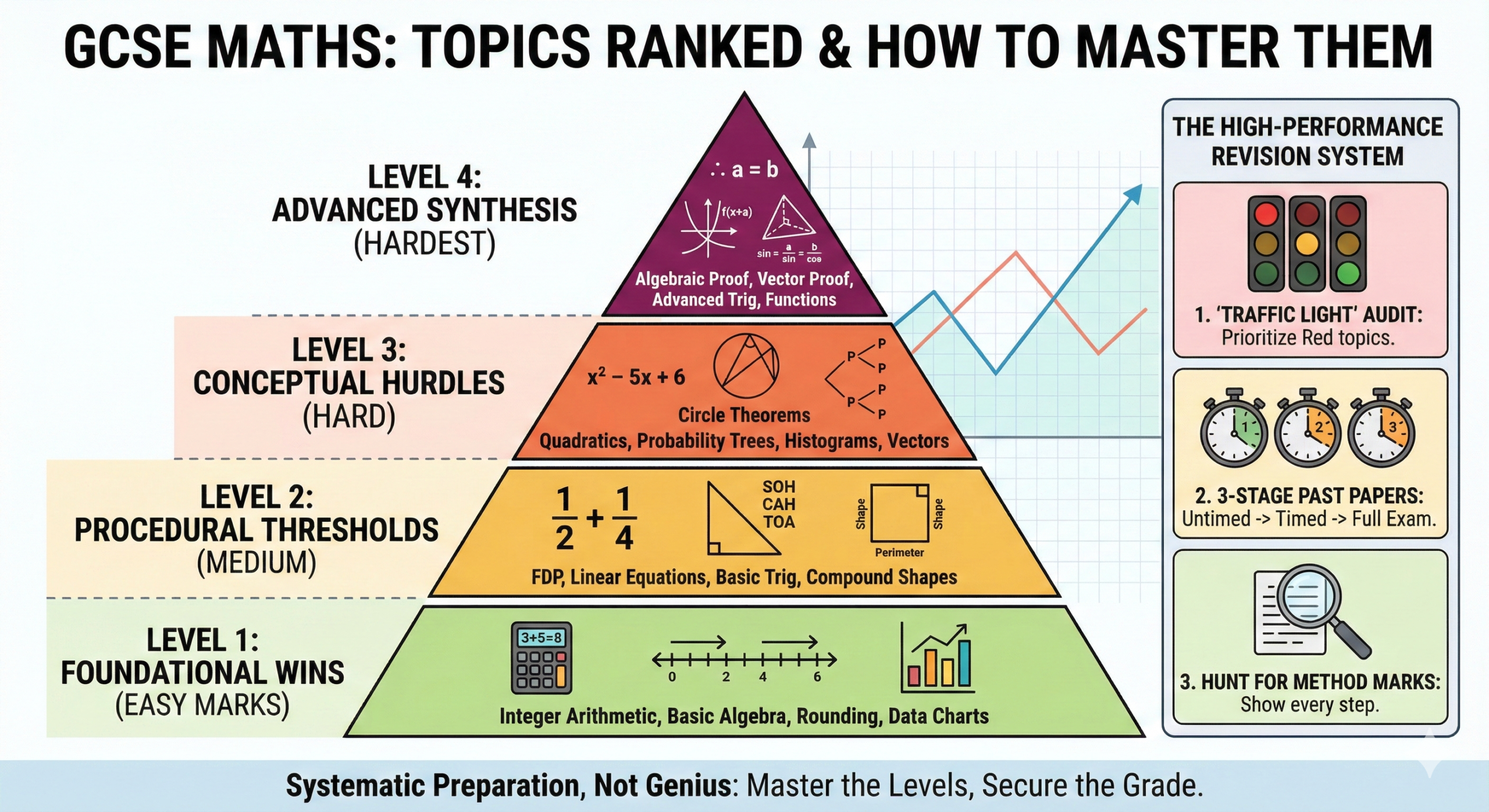
1. Level 1: Foundational Wins (The “Easy” Marks)
These topics typically appear at the start of the paper. They rely on standard procedures and have the highest national success rates.
- Integer Arithmetic: Addition, subtraction, multiplication, division, prime numbers, factors, and multiples.
- Standard Form & Ordering: Ordering numbers by magnitude and basic standard form calculations.
- Basic Data Representation: Drawing and reading bar charts, pictograms, and stem-and-leaf diagrams.
- Elementary Algebra: Simplifying expressions (collecting like terms) and simple laws of indices.
- Rounding and Estimation: Rounding numbers to check the “reasonableness” of your final answers.
Why this matters: These topics are the bedrock of your grade. Losing marks here due to silly calculation errors puts you at an immediate disadvantage.
Pro-Tip: Do not skip revising these just because they feel easy. Drill them until your accuracy is 100% so you can breeze through the first 20 minutes of your exam and bank the marks.
2. Level 2: Procedural Thresholds (Medium)
These topics require you to integrate multiple steps or apply basic concepts to real-world contexts.
- Fractions, Decimals, and Percentages (FDP): Percentage increases/decreases and reverse percentages.
- Linear Equations & Inequalities: Solving equations with unknowns on both sides and representing inequalities on number lines.
- Basic Trigonometry & Pythagoras: Applying a^2 + b^2 = c^2 and SOH CAH TOA in right-angled 2D triangles.
- Compound Shapes: Calculating area and perimeter by breaking complex polygons into simpler rectangles.
- Compound Measures: Speed, distance, time, and density/mass/volume problems (especially those requiring unit conversions).
Why this matters: This is where the paper starts separating the foundational students from the mid-tier achievers. The math isn’t necessarily harder, but the problem-solving aspect increases.
Action Step: Memorize your formulas (like SOH CAH TOA). You cannot rely on a formula sheet in the modern exam format.
3. Level 3: Conceptual Hurdles (Hard)
Welcome to the higher-tier separators. These topics require linking different mathematical strands or handling abstract, non-numerical concepts.
- Quadratic Equations & Sequences: Factorizing quadratics and finding the nth term using the second difference.
- Circle Theorems: Applying multiple theorems to a single diagram and providing precise geometric reasoning.
- Probability Trees & Venn Diagrams: Conditional probability and combined events (e.g., sampling without replacement).
- Histograms: Making the conceptual leap from “frequency” to “frequency density.”
- Vector Arithmetic: Describing vector paths in terms of variables within geometric grids.
Why this matters: Level 3 tests your spatial awareness and logic. You can’t just “plug numbers into a calculator” here; you have to prove why something is true.
Pro-Tip: For Circle Theorems, physically draw on the exam paper. Mark parallel lines, highlight angles, and use highlighters to trace the shapes.
4. Level 4: Advanced Synthesis (The Hardest)
These topics are typically exclusive to the Higher tier and are placed at the end of the exam to differentiate the Grade 8 and 9 students from the rest.
- Algebraic Proof: Consistently ranked as the most abstract and difficult topic. It requires building a logical argument step-by-step rather than arriving at a numerical result.
- Vector Proof & Collinearity: Using algebraic scalars to prove lines are parallel or points lie on a straight line.
- Non-Linear Simultaneous Equations: Solving pairs of equations where one is linear and the other is quadratic (e.g., a line intersecting a circle).
- Advanced Trigonometry: Identifying when to use the Sine rule, Cosine rule.
“To conquer algebraic proof, you must stop trying to ‘find the answer’ and start focusing on ‘building the argument.’ Practice writing logical structures from scratch.”
How to Pass: The High-Performance Revision System
Knowing what is hard is only the first step. Here is the operational system you need to master the syllabus.
1. The “Traffic Light” Audit
Don’t just revise what you already know. Print the syllabus and categorize every topic:
- Red: I have no idea how to do this.
- Amber: I understand the concept but make mistakes.
- Green: I can solve these consistently.Prioritize your “Red” and “Amber” topics to make the biggest leaps in your grade, but mix in “Green” topics occasionally to maintain your confidence.
2. The 3-Stage Past Paper Strategy
Past papers are the single most effective revision tool, but most students use them wrong. Treat them as a training protocol:
- Stage 1 (Untimed & Open Book): Focus entirely on getting familiar with the language and structure of the questions.
- Stage 2 (30-Minute Sprints): Do sections under timed conditions to build speed.
- Stage 3 (Full Simulation): Replicate full exam conditions; no phone, no notes, strict time limits.
Action Step: After every paper, create a Mistake Log. Write down the topic, why you got it wrong (was it a silly calculation slip or a conceptual misunderstanding?), and write out the flawless solution.
3. Hunt for Method Marks
GCSE examiners award method marks. Even if you punch the wrong number into your calculator at the very end, writing down each stage of your thought process, the formulas you used, and your substitutions can secure you 3 out of 4 marks on a complex question.
4. Calculator & Exam Hygiene
- Read the Question: Underline keywords. Don’t calculate the area when the question asks for the perimeter.
- Avoid Cumulative Rounding: Keep full decimal values stored in your calculator. Only round your number at the very final step; otherwise, your answer will drift away from the marking scheme’s accepted range.
- The 1-Minute Rule: Stick to the “1 mark = 1 minute” rule. If a 2-mark question is taking you 5 minutes, leave it. Secure the easy marks first and return to the difficult ones later.
Final Thoughts
Passing GCSE Maths is not about natural genius; it is about systematic preparation. It is about identifying your weak points, understanding how the exam is structured, and drilling your technique until it becomes second nature.
Are you currently organizing your revision by difficulty, or are you just reading the textbook from front to back and hoping for the best? @supermuneeeb
Blog
This section provides an overview of the blog, showcasing a variety of articles, insights, and resources to inform and inspire readers.
-
5 Powerful IGCSE Physics Topics to Master Before May
Spread the loveEight weeks out. Here are the five Physics topics most likely to cost…
-
Are Predicted Papers Worth It? Honest IGCSE 2026 Truth
Spread the loveEvery student is searching for them right now. But do predicted papers actually…
-

War Abroad, Schools Closed at Home: What Pakistani Students Must Do Now
Spread the lovePunjab has shut all schools until 31 March 2026. Your exams have not…

Leave a Reply