
Eight weeks out. Here are the five Physics topics most likely to cost you marks in May 2026, and exactly how to prepare for each one.
By Muneeb Farooq · March 2026 · 8 min read · For Students
Let me be upfront about something first. No tutor, revision company, or predicted paper provider knows exactly what will appear in your May 2026 Physics exam. Anyone claiming otherwise is either misleading you or selling you something.
What we do know, after years of analysing past papers, examiner reports, and topic weightings across Cambridge, Edexcel, and OxfordAQA, is which topics appear consistently, carry the most marks, and are most frequently mishandled by students.
That is a different conversation. And it is a far more useful one.
Here are the five topics every IGCSE Physics student should have locked down before May 2026.
1. Forces and Motion
This is the single most consistently examined topic across all three major exam boards. Cambridge 0625, Edexcel 4PH1, and OxfordAQA 9203 all dedicate significant mark allocation to Forces and Motion every single year without exception.
What students consistently get wrong here is not the basic definitions. It is the application. Specifically:
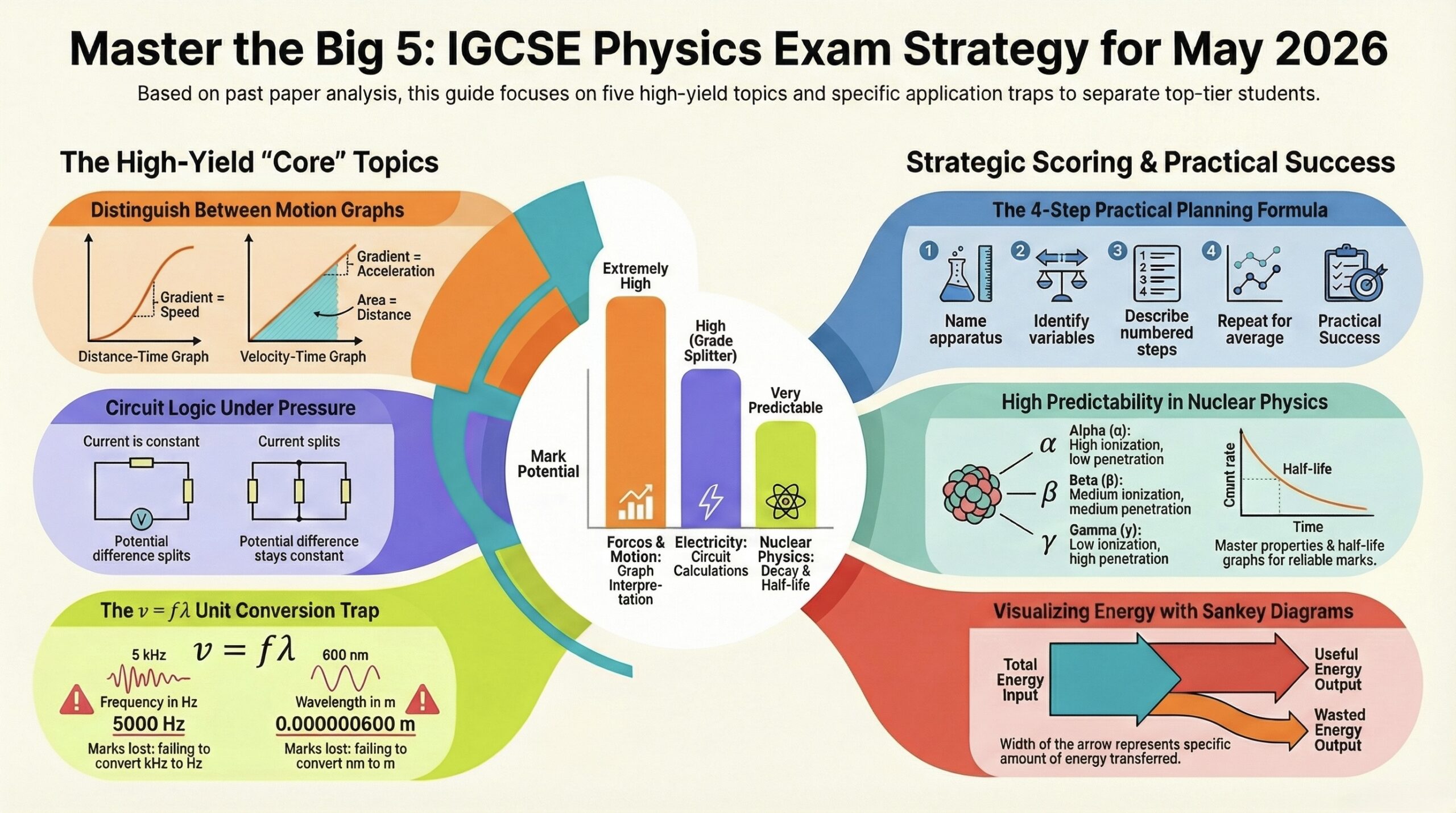
Distance-time and velocity-time graphs. Every year, students lose marks by confusing the two. On a distance-time graph, the gradient gives you speed. On a velocity-time graph, the gradient gives you acceleration and the area under the graph gives you distance. These are not the same thing. Practise reading both under timed conditions until the distinction is automatic.
Newton’s Second Law calculations. F = ma questions are almost guaranteed to appear. The marks are not lost on the formula. They are lost on unit conversion. Make sure you are working in Newtons, kilograms, and metres per second squared consistently.
Terminal velocity. Examiners love asking students to explain terminal velocity in terms of forces. A common student answer describes what happens without explaining why. The mark scheme wants you to explicitly state that at terminal velocity, the driving force equals the resistive force, so the resultant force is zero and acceleration is zero. Write it in those exact terms.
2. Electricity and Circuits
Electricity is the second highest-yield topic across all exam boards and the one where the gap between a C grade student and an A* student is most visible.
The marks students consistently drop here fall into two categories.
Series and parallel circuit calculations. In series circuits, current is the same throughout and potential difference splits across components. In parallel circuits, potential difference is the same across each branch and current splits. Students mix these up under pressure. The fix is simple: practise at least 20 circuit calculation questions from past papers before your exam.
Resistance and Ohm’s Law. V = IR questions are straightforward until they are embedded inside a multi-step problem. Practise questions where you need to find resistance from a graph, not just from given values. Examiners increasingly present data graphically rather than numerically.
Electrical power. P = IV and P = I²R both appear regularly. Know both. Know when to use each one based on what values you are given.
3. Waves and the Electromagnetic Spectrum
Waves is a topic many students underestimate because the early content feels straightforward. The difficulty increases significantly in the application questions.
The wave equation. v = fλ is one of the most frequently tested calculations in IGCSE Physics. It is also one of the most frequently bungled because students forget to convert units. If frequency is given in kHz, convert it to Hz before substituting. If wavelength is given in nm, convert to metres. Unit errors cost marks every single year.
The electromagnetic spectrum. Every exam board tests this. You need to know the order from radio waves to gamma rays, the relative wavelengths and frequencies, and at least two uses and two dangers for each type of radiation. Do not just memorise the order. Understand the pattern.
Refraction and Snell’s Law. For Cambridge and Edexcel extended tier students, refraction calculations using n = sin i / sin r appear regularly. Practise drawing accurate ray diagrams and showing the normal line clearly. Marks are awarded for diagram accuracy, not just the calculation.
4. Energy Transfers and Efficiency
Energy is a topic that appears across multiple sections of the paper and carries marks in contexts students do not always expect. It shows up in Forces questions, in Electricity questions, and in its own dedicated section.
The efficiency formula. Efficiency = (useful output energy / total input energy) x 100. Simple enough. But examiners regularly present this in unfamiliar contexts. A question might give you the efficiency and ask you to find the wasted energy. Practise working the formula in all directions.
Sankey diagrams. These appear more frequently than students expect, particularly in Cambridge papers. The width of each arrow represents the amount of energy. You need to be able to draw them accurately and interpret them quickly.
Energy stores and transfers. The language matters here. Cambridge specifically wants students to describe energy in terms of stores (kinetic, gravitational potential, thermal, chemical) and transfers (mechanically, electrically, by heating, by radiation). Using old language can cost you marks on command word questions asking you to describe an energy transfer.
5. Nuclear Physics and Radioactivity
Nuclear Physics carries fewer marks than the topics above but is one of the most predictable sections of any IGCSE Physics paper. The questions are highly structured and follow a consistent pattern year after year. This makes it one of the easiest areas to pick up marks efficiently with the right preparation.
Alpha, beta, and gamma radiation. You must know the nature of each type, its penetrating power, its ionising ability, and how it is affected by electric and magnetic fields. Examiners ask this in different formats but the underlying knowledge required is always the same.
Half-life calculations. Half-life questions appear in virtually every Cambridge and Edexcel paper. Practise both reading half-life from a graph and calculating the remaining activity after a given number of half-lives. These are reliable marks if you prepare for them specifically.
Nuclear equations. For extended tier students, balancing nuclear equations for alpha and beta decay is a regular feature. The key rules are that mass number and atomic number must both balance on each side of the equation.
A Note on Paper 6: Alternative to Practical
If you are sitting Cambridge 0625 or Edexcel 4PH1, Paper 6 represents a significant portion of your final grade and is the paper most students prepare for least.
The planning question in Paper 6 follows an almost identical structure every year. Name your apparatus specifically, state your independent and dependent variables, list at least two controlled variables, describe your method in numbered steps, and always include “repeat the experiment and calculate an average.” That structure alone is worth several marks every year.
Do not leave Paper 6 until the week before your exam. Give it at least two dedicated practice sessions in the final four weeks.
How to Use This List
Do not read this and immediately start making notes on all five topics. That is not how to use it.
Instead, go through your specification checklist for your exam board and rate your current confidence on each of these five topics out of 5. Start with whichever topic scored lowest. Work through past paper questions on that topic specifically, mark them using the official mark scheme, and note exactly where marks were lost.
Then move to the next topic. Repeat until all five are at a 4 or 5.
Official past papers for all three exam boards:
Final Thought
Physics is not a subject where effort alone determines your grade. Strategy matters. Knowing which topics carry the most marks, where students consistently drop points, and how to answer in the exact language the mark scheme rewards is what separates an A from an A*.
You have the time. Use it on the right things.
Struggling with any of these topics? I offer one-to-one IGCSE Physics tutoring for students across the UK, UAE, Pakistan and the Gulf. Book a free consultation here.
Blog
This section provides an overview of the blog, showcasing a variety of articles, insights, and resources to inform and inspire readers.
-
5 Powerful IGCSE Physics Topics to Master Before May
Spread the loveEight weeks out. Here are the five Physics topics most likely to cost you marks in May 2026, and exactly how to prepare for each one. By Muneeb Farooq ·…
-
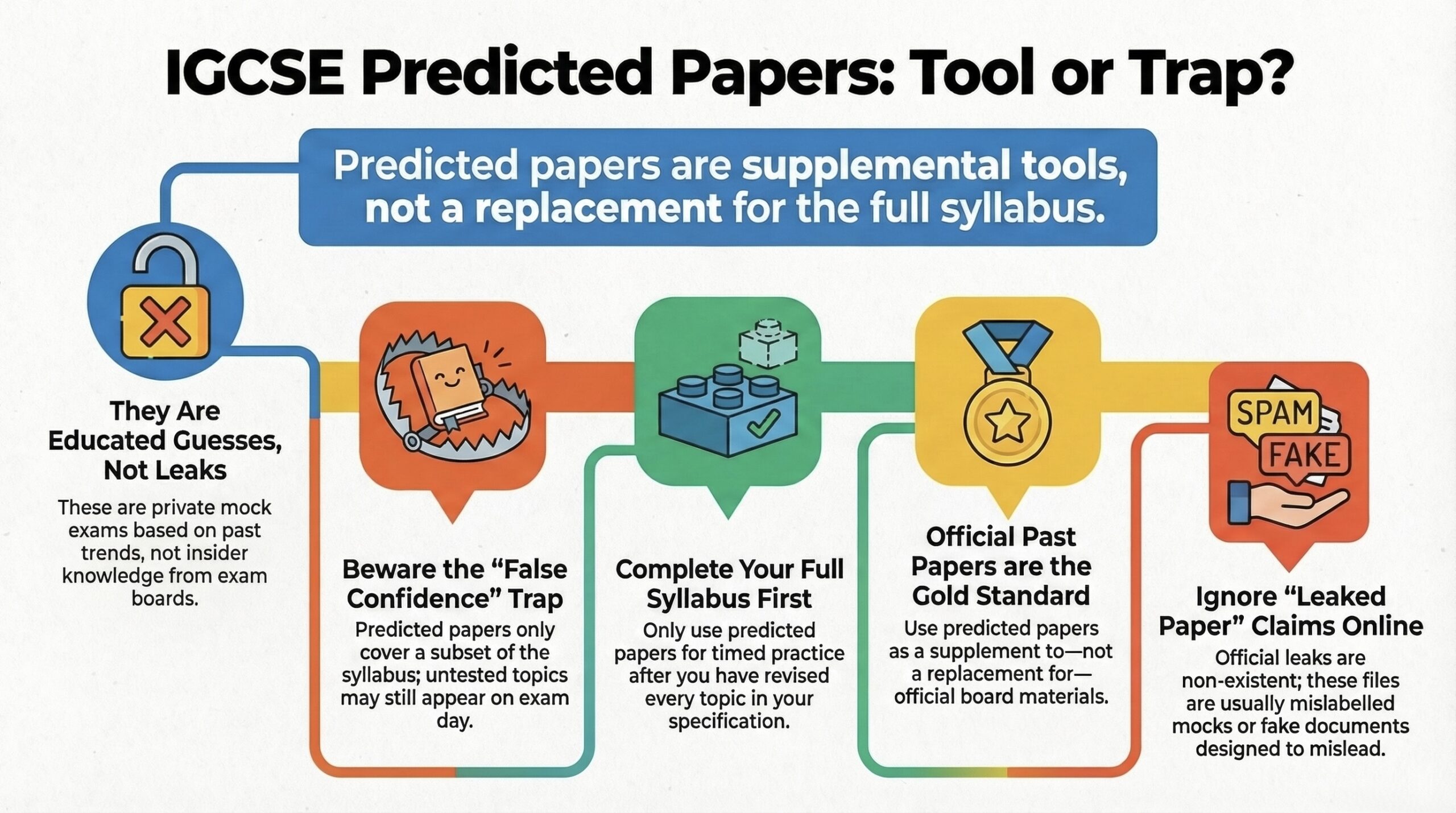
Are Predicted Papers Worth It? Honest IGCSE 2026 Truth
Spread the loveEvery student is searching for them right now. But do predicted papers actually help, or are they a dangerous distraction with 8 weeks to go? By Muneeb Farooq · March…
-

War Abroad, Schools Closed at Home: What Pakistani Students Must Do Now
Spread the lovePunjab has shut all schools until 31 March 2026. Your exams have not moved. Here is what every student and parent needs to know right now. By Muneeb Farooq ·…

Leave a Reply